The Himalayan Legacy: Why Nepal Has Become the Undisputed Capital of the Global Handmade Felt Industry
Explore how Nepal became the global leader in handmade felt through skilled craftsmanship, sustainable wool production, and ethical artisan traditions.
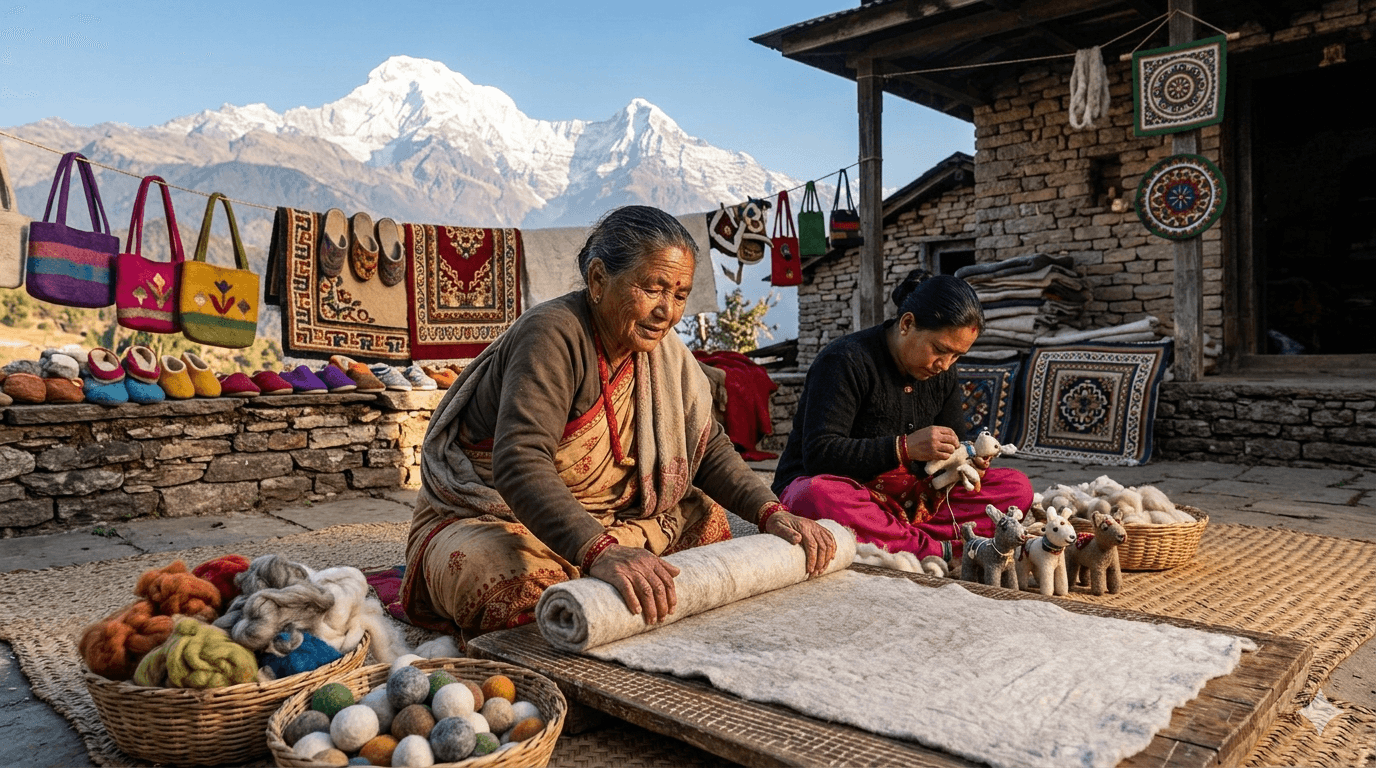
The Himalayan Legacy: Why Nepal Has Become the Undisputed Capital of the Global Handmade Felt Industry — Handmade felt crafting insights from Kathmandu, Nepal
There's a Reason Every Major Felt Brand Points to Nepal
Ask any wholesale buyer in the sustainable product space where they source their felt, and the answer comes back with striking consistency: Nepal. Ask a Montessori toy designer, a corporate gifting company, a zero-waste lifestyle brand, or an Etsy top seller — they're all either sourcing from Nepal already or actively looking to.
This isn't coincidence. Nepal's dominance in the global handmade felt industry is the product of geography, culture, craft tradition, economic structure, and raw material abundance converging in a single country over generations. No other country on earth has been able to replicate what Nepal has built — and that's precisely why international demand for Nepali felt products continues to grow even as manufacturing globalizes and supply chains diversify.
This is the story of how Nepal became the world's felt capital — and why it matters for businesses, buyers, and brands sourcing in 2026.
The Geographic Foundation: Himalayan Wool at the Source
The story of Nepali felt begins with wool — specifically, the extraordinary quality of wool produced in Nepal's high-altitude regions.
Nepal's geography spans some of the world's most dramatic elevations. From the subtropical Terai plains to the alpine highlands above 4,000 meters, the country hosts diverse sheep breeds whose wool characteristics are shaped directly by the harsh mountain environment. Himalayan sheep, including breeds raised in the high-altitude regions near Tibet, produce wool with natural properties that are highly prized for felt-making:
Fiber length and crimp: Mountain wool tends to have a natural crimp (waviness) that facilitates the interlocking of fibers during the felting process. This produces felt that is denser, more durable, and more dimensionally stable than felt made from lower-quality fiber.
Lanolin content: Himalayan wool retains significant natural lanolin, which contributes to felt's natural water resistance and tactile softness. This is a characteristic that manufacturers working with synthetic or lower-quality wool blends simply cannot replicate.
Natural color range: Himalayan sheep produce wool in a wider natural color range than commercial breeds, from bright white to rich greys and browns. This diversity gives felt makers a broader palette to work with before any dyeing takes place.
Nepal also benefits from proximity to Tibet, which has historically been one of the world's finest wool-producing regions. The cross-border trade in raw fiber has given Nepali felt makers access to Tibetan wool — arguably the most premium natural fiber available for felt production.
The Cultural Foundation: Centuries of Craft Tradition
Geography explains the raw material. Culture explains the skill.
Wool processing and textile craft have been central to Nepali life for centuries. In the high mountain communities of the Himalayas — Sherpa communities, Tamang villages, communities along ancient trade routes connecting the Subcontinent with Tibet and China — wool was not just a material. It was a survival resource. The ability to process, dye, and construct wool textiles was a fundamental life skill passed from generation to generation.
Traditional Nepali wool crafts include:
Thangka textile arts — elaborate symbolic textiles used in Buddhist practice
Dhaka weaving — complex hand-loom work using cotton and wool blends
Carpet weaving — the Tibetan-Nepali knotted carpet tradition is world-famous and shares many techniques with felt production
Natural dyeing — Nepal has a deep tradition of natural dye use, including plant-based dyes from madder, indigo, turmeric, walnut, and pomegranate
When the felt export industry began developing in Kathmandu in the 1980s and 1990s — initially driven by demand from European buyers interested in handicrafts — it didn't start from scratch. It built on a foundation of existing craft knowledge and a workforce that already understood fiber, color, and textile construction at an intimate level.
This is why Nepali felt artisans can execute complex designs — intricate toy patterns, precise geometric shapes, detailed character faces with lifelike expressions — that manufacturers in other countries struggle to replicate without highly specialized (and expensive) machinery.
The Economic Structure: Why Nepal's Cost Advantage Isn't Going Away
One of the most common misconceptions about Nepal felt products is that the price advantage is simply about "cheap labor" in the way that mass manufacturing in Vietnam or Bangladesh might be. This fundamentally misunderstands what makes Nepal's felt industry competitive.
Nepal's felt industry is structured around cooperative artisan production, not factory-floor mass manufacturing. The cost advantage comes not from exploitative wages but from:
Lower overhead structure: Artisan cooperatives and small workshops in Nepal operate with far lower overhead than equivalent production facilities in Europe, North America, or Australia. They don't require industrial HVAC, expensive machinery maintenance, or large-footprint factory spaces. Felt production, at its core, requires skilled hands, basic tools, and the raw material — and Nepal has all three in abundance.
Local raw material availability: Because raw wool is locally sourced, Nepal-based producers don't face the import costs and supply chain complexity that producers in countries without domestic wool supply must absorb.
Generational skill density: When a workforce has practiced a craft for generations, training costs are minimal. A new artisan entering the Nepal felt industry enters a knowledge environment where techniques, quality standards, and production methods are already embedded in community knowledge.
Fair trade premiums and market access: Nepal's felt industry has strong integration with international fair trade networks. Many producers are certified by organizations like the World Fair Trade Organization (WFTO). These certifications provide preferential market access to buyers in Europe and North America who specifically seek fair trade-verified suppliers — a market segment that competes on quality and ethics rather than lowest price.
The result is a cost structure that is genuinely competitive at the wholesale level while also being ethically sound at the production level — a combination that is very rare in global manufacturing.
Kathmandu Valley: The Hub of Nepal's Felt Export Industry
While felt production occurs across Nepal, the Kathmandu Valley — Nepal's capital region — functions as the commercial hub for felt export. Within the Valley, several districts have become particularly associated with felt production and export:
Lalitpur (Patan): Historically the center of Nepali handicraft production, Patan is home to numerous felt workshops, cooperatives, and export companies. The Patan area has a particularly strong tradition of mixed-craft production, and many of Nepal's most sophisticated felt manufacturers operate here.
Kathmandu proper: The wholesale and export infrastructure is concentrated in Kathmandu, including trading companies, quality control operations, and logistics providers who specialize in handmade goods export.
Bhaktapur: Known for its traditional pottery and woodwork, Bhaktapur also has a significant felt production community, particularly for smaller decorative items.
The Valley's concentration of artisan skill, wholesale infrastructure, and export logistics makes it possible for international buyers to source comprehensively — including visiting producers, meeting artisans, conducting quality inspections, and arranging shipment — all within a compact geographic area.
This density is another competitive advantage that Nepal has over countries where production is dispersed and supply chain management is more complex.
What Nepal Felt Manufacturers Can Produce: The Full Spectrum
A common misconception among first-time buyers is that Nepal felt production is limited to simple items — felt balls, basic coasters, folk art ornaments. This significantly underestimates the range of what Nepal's felt industry is capable of producing.
Toys and Play Products
Complex 3D stuffed animals and characters, play food sets, finger puppet collections, stacking toys, puzzle-format flat toys, miniature Montessori activity toys, doll furniture, and interactive felt boards. Nepal's artisans have developed the pattern-making and construction skills to produce toys that meet international safety standards and compete on quality with the best handmade toy brands globally.
Home Décor and Textiles
Felt ball garlands and mobiles, wall hangings, macramé-felt hybrid pieces, area rugs and mats, cushion covers, placemats, coasters, table runners, room dividers, and acoustic panel systems. Nepal produces both decorative items for the consumer market and functional acoustic products for the commercial interior design sector.
Looking for custom or wholesale handmade felt crafts?
Direct artisan manufacturer in Nepal • 100% pure wool • Low MOQs & worldwide shipping
Fashion and Accessories
Hats, bags, coin purses, laptop sleeves, jewelry, slippers and footwear, scarves, and felt-embellished clothing. Nepal's fashion felt segment is growing rapidly as international fashion brands look for sustainable, handmade accessory options.
Corporate and Business Products
Branded desk organizers, cable managers, coasters with logo embroidery, welcome kit components, gift box inserts, pen holders, tech accessories, and trade show giveaways. This is one of the fastest-growing export categories as B2B buyers recognize felt's potential for premium corporate merchandise.
Packaging and Presentation
Felt pouches, gift bags, wine bottle holders, jewelry presentation inserts, retail packaging liners, and product-specific cases and carriers. Brands in the luxury, beauty, and consumer goods space increasingly use felt packaging components as a differentiation strategy.
Seasonal and Holiday Products
Christmas ornaments, advent calendars, Easter baskets, Halloween decorations, Diwali-inspired decorative products, and custom holiday gift sets. Nepal's seasonal production capacity is well-established, with many manufacturers producing year-round for the Northern Hemisphere holiday market.
Quality Standards and Certifications in Nepal's Felt Industry
The quality of felt products from Nepal varies — as it does in any country. Understanding the quality indicators and certification landscape helps buyers source confidently.
What to Look For in a Nepal Felt Manufacturer
Color fastness: Quality felt should not bleed when wet. Ask for samples to test with water. Reputable manufacturers use azo-free reactive dyes that are colorfast and safe.
Density and weight: Felt thickness should be consistent throughout the product. "Dead spots" (areas where the felt has not fully compressed) indicate poor production. Hold felt up to light — even density shows even compression.
Stitching quality: On sewn felt products, examine stitch length, thread tension, and seam strength. Quality products will have consistent 2–3mm stitch length with no loose threads or gaps at seam intersections.
Stuffing material: For 3D stuffed felt products, ask about stuffing materials. Recycled polyester fiberfill and natural wool stuffing are both acceptable. Cheap foam or low-grade synthetic stuffing affects the product's longevity and eco credentials.
Safety compliance: For toys, check whether the manufacturer has experience producing for markets with strict toy safety standards (EN71 in Europe, ASTM F963 in the US). Reputable Nepal toy manufacturers will have documentation and testing experience for these standards.
Relevant Certifications
GOTS (Global Organic Textile Standard): Certifies organic fiber sourcing and responsible manufacturing processes. Not universally available among Nepal producers but increasingly common among export-focused manufacturers.
Oeko-Tex Standard 100: Tests for harmful substances in the finished product. A highly credible and internationally recognized certification.
WFTO Fair Trade: Verifies fair wages, safe working conditions, and ethical business practices. Many Nepal felt cooperatives carry this certification.
CE Marking / EN71: European toy safety compliance. Essential if you're selling into European markets.
The Artisan Story: Why It Matters for Your Brand
Beyond the purely functional considerations of quality and cost, there's a brand value dimension to sourcing from Nepal that deserves explicit attention.
In 2026, consumers are deeply interested in provenance. They want to know who made the products they buy, under what conditions, and what impact their purchase has in the world. Nepal-sourced felt products give brands a genuine, compelling story to tell:
Products made by skilled artisans in the Himalayan region
Craft traditions passed down through generations
Supporting family businesses and cooperative employment in one of Asia's developing economies
Creating livelihoods that provide dignified, skilled work — not assembly-line repetition
Preserving traditional craft techniques in a world of mass production
This story is not manufactured for marketing purposes. It's real. And in the current consumer climate, authenticity of this kind is extraordinarily valuable.
Brands that share this story — in their product descriptions, their packaging inserts, their social media content, their website's "about" sections — build deeper connections with their customers than brands that treat manufacturing as an invisible back-end process.
How to Find and Vet a Nepal Felt Manufacturer
If you're ready to source from Nepal, here's a practical starting framework:
1. Start with B2B platforms and trade directories. Platforms like Alibaba, DHgate, and Global Sources have Nepal felt manufacturers listed, but the better quality producers are often found through direct web searches, trade show directories (like Ambiente Frankfurt or NY NOW), or referrals from other buyers.
2. Request a comprehensive sample pack. Before committing to any order, request samples across your target product categories. Pay for samples — serious manufacturers charge for samples to filter out non-serious inquiries, and sample cost is usually deductible from your first order.
3. Conduct a video factory visit. Most Nepal manufacturers are willing to do a video call tour of their facility. This gives you a sense of the production environment, workforce, and quality of work in progress.
4. Check references. Ask for references from other international buyers in your target market (US, Europe, Australia). A manufacturer with satisfied buyers in your market has already navigated the quality standards and logistics requirements relevant to you.
5. Start with a trial order. Even if a manufacturer passes all your vetting, place a smaller trial order before committing to large volumes. Test the actual product quality, packaging, shipping timeline, and communication responsiveness before scaling.
The Future of Nepal's Felt Industry
Nepal's felt industry is not standing still. The next generation of Nepal-based felt manufacturers is investing in:
Design capabilities — moving beyond execution of buyer-provided designs to offering in-house design services
Digital marketing — direct-to-consumer online stores that serve international customers without intermediary wholesalers
Certification depth — pursuing GOTS, Oeko-Tex, and organic certifications to serve the highest-demand market segments
Product innovation — expanding into new categories like acoustic panels, architectural felt installations, and technical felt applications
The Himalayan legacy is alive, evolving, and ready to serve the global market's growing demand for sustainable, handmade, beautiful products. For brands looking to build on that foundation, the partnership opportunity has never been more compelling.
Frequently Asked Questions
What is the average lead time for felt products from Nepal? Production lead times typically range from 2–6 weeks depending on product complexity and order volume. Ocean freight shipping adds 3–5 weeks to Europe and North America. Air freight is faster (5–10 days) but significantly more expensive per kg.
What is the typical MOQ for Nepal felt manufacturers? Many Nepal manufacturers accept MOQs of 50–200 pieces per design for standard products. For fully custom designs, MOQs of 100–500 pieces are common. Some smaller cooperatives accept even lower MOQs for established buyer relationships.
Can Nepal manufacturers handle product development from scratch? Many yes. Experienced Nepal felt manufacturers can work from a sketch, reference image, or concept description to develop patterns, samples, and production specifications. This design-to-production capability makes them strong partners for brands developing new product lines.
Is shipping from Nepal reliable? Nepal is a landlocked country, so all international shipping goes through air or surface routes via India (primarily through Kolkata or Delhi). Shipping reliability has improved significantly in recent years, and established freight forwarders have well-tested Nepal routes. Ocean freight to Europe takes approximately 5–7 weeks including consolidation and transit; to the US West Coast approximately 6–8 weeks.
Interested in sourcing handmade felt products from Nepal? Felt and Wool Craft to discuss your requirements, request samples, and get wholesale pricing.
Tags: Nepal felt manufacturer, handmade felt products Nepal, Kathmandu felt export, sustainable sourcing Nepal, wool felt wholesale Asia, Nepal artisan crafts, Himalayan wool felt
Looking for Custom or Bulk Handmade Felt Crafts?
We manufacture premium 100% pure New Zealand wool felt products directly in Kathmandu, Nepal. Supporting ethical fair trade, custom OEM branding, low MOQs, and reliable worldwide express shipping.