Pricing & Shipping Explained for Felt Wholesale Buyers: Everything You Need to Know Before Placing Your First Order
One of the biggest mistakes new wholesale buyers make is focusing only on the unit price from the supplier.
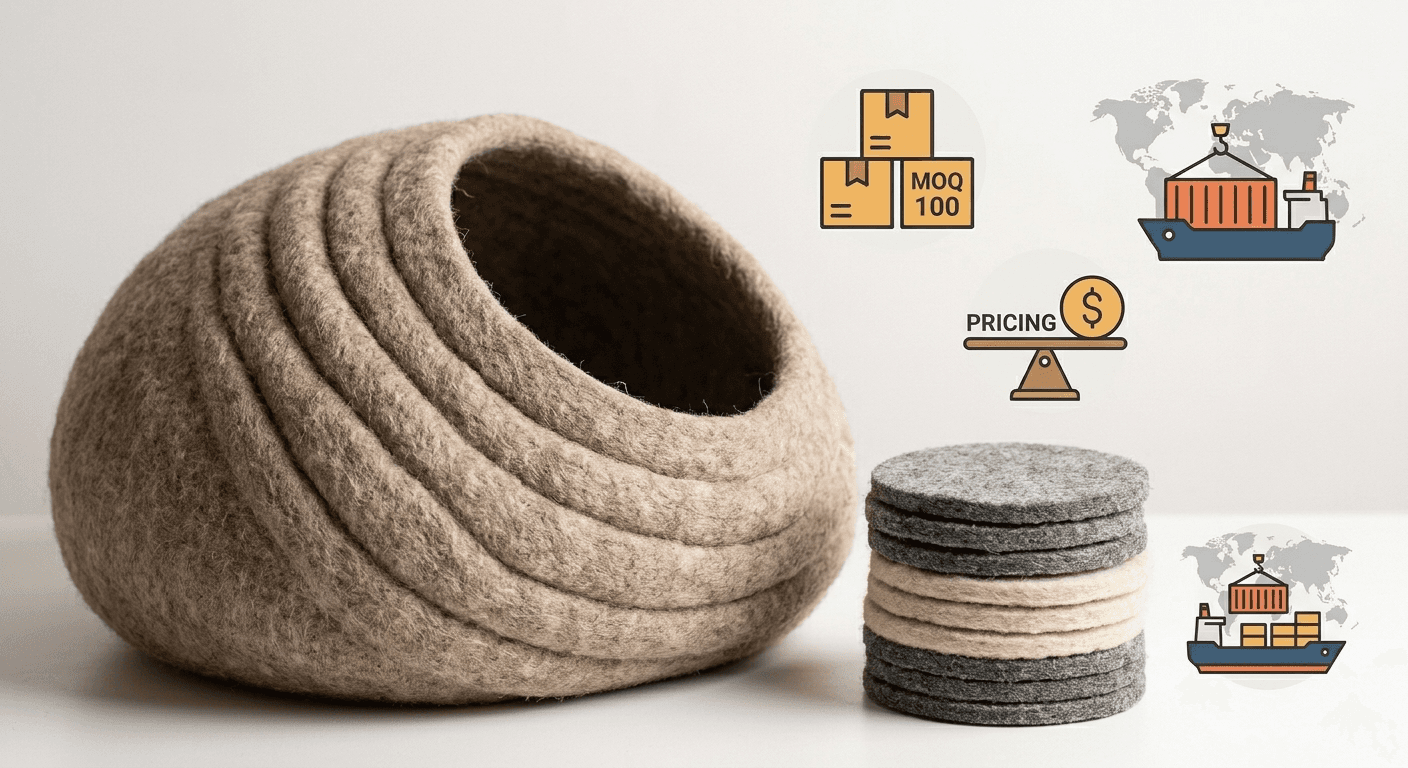
Pricing & Shipping Explained for Felt Wholesale Buyers: Everything You Need to Know Before Placing Your First Order — Handmade felt crafting insights from Kathmandu, Nepal
New to wholesale felt buying? Confused by MOQs, EXW pricing, and air freight vs. sea freight? This comprehensive guide breaks down every commercial term you'll encounter when buying felt products wholesale from Nepal — so you can budget accurately, negotiate confidently, and avoid costly surprises.
Introduction: Why Understanding These Terms Matters
One of the biggest mistakes new wholesale buyers make is focusing only on the unit price from the supplier. They see $1.50 per felt cat toy and think, "That's amazing — I'll sell it for $12.99 and make a fortune." Then the shipment arrives and the actual landed cost per unit was $4.80 after shipping, duties, and fees. Suddenly the margins look very different.
Understanding MOQ (Minimum Order Quantity), pricing structures, and shipping options before you place an order is the difference between a profitable product line and a frustrating experience.
This guide covers everything wholesale buyers need to know when purchasing handmade felt products from Nepal.
Part 1: Understanding MOQ (Minimum Order Quantity)
What Is MOQ?
MOQ stands for Minimum Order Quantity — the smallest number of units a manufacturer will produce or sell in a single order. It exists because handmade manufacturing has fixed setup costs: organizing artisans, sourcing raw wool, setting up production batches, and quality control all take time regardless of whether you order 10 pieces or 1,000.
Typical MOQs for Felt Products from Nepal
MOQs vary by product type, complexity, and supplier. Here are realistic benchmarks:
Product TypeTypical MOQNotesFelt balls (1cm–5cm)100–500 piecesLower per-color MOQ may applyFelt cat toys50–200 piecesPer design/shapeFelt Christmas ornaments50–200 piecesPer designFelt garlands50–100 piecesPer styleFelt rugs (small, 2x3 ft)10–50 piecesHigher labor cost per unitFelt rugs (large, 4x6 ft)5–20 piecesFelt bags and purses30–100 piecesPer color/designFelt wall hangings10–50 piecesPer designFelt coasters (set of 4)50–100 setsFelt plant pots30–100 piecesPer sizeCustom/private label itemsVaries (often 100+)Depends on complexity
How to Negotiate MOQ as a Small Buyer
If you're a small business or just starting out, high MOQs can feel like a barrier. Here's how to work around it:
1. Mix and match: Ask if the MOQ applies to total quantity across styles, not per individual design. For example, 200 felt cat toys total (100 in fish shape, 100 in mouse shape) rather than 200 of each.
2. Start with a test order: Many suppliers, including feltandwoolcraft.com, offer lower MOQs for first-time buyers to help establish the relationship.
3. Be transparent: Tell the supplier you're a new buyer testing the market. Experienced exporters understand that small buyers can become large accounts over time.
4. Pay full price for small quantities: If you genuinely need a very small quantity, some suppliers will accommodate at a slightly higher unit price. This is fair — you're compensating for their reduced efficiency.
Part 2: Understanding Felt Wholesale Pricing
How Felt Product Pricing Is Structured
When a Nepal felt manufacturer quotes you a price, it's usually in one of these terms:
EXW (Ex Works): The base factory price. Does not include any export packing, domestic transport to the airport/port, export customs clearance, or freight. The buyer arranges everything from the factory door.
FOB (Free On Board): Factory price + export packing + transport to the port/airport + export customs clearance. This is the most common pricing term used with Nepal exporters. Once goods are loaded onto the carrier, risk transfers to the buyer.
CIF (Cost, Insurance, Freight): FOB price + international freight + insurance. The seller arranges and pays for shipping to the buyer's destination port. Risk still transfers at origin port.
DDP (Delivered Duty Paid): The seller handles everything including international freight, import customs, and duties. You receive goods at your door. Most expensive option but lowest hassle for buyers.
For most Nepal wholesale transactions, FOB Kathmandu (or FOB Tribhuvan International Airport for air freight) is the standard.
Price Tiers: How Volume Affects Your Cost
Handmade product pricing is highly volume-sensitive. Here's a realistic illustration:
Example: Felt Cat Toy (mouse shape, 100% wool)
Order QuantityUnit Price (FOB Nepal)50 pieces$1.80100 pieces$1.50300 pieces$1.20500 pieces$0.951,000+ pieces$0.75
This is why experienced wholesale buyers place larger orders — the unit economics improve dramatically, and the margin on retail sale expands significantly.
What Drives the Price of Felt Products?
Several factors affect the price your supplier quotes:
1. Wool quality: 100% merino wool costs more than standard sheep wool or synthetic felt. Premium wool means better softness, durability, and color vibrancy — and higher prices that you can justify to your customers.
2. Product complexity: A simple felt ball is less labor-intensive than a multi-piece felt Christmas ornament with intricate needle-felted detail. Complexity = higher price.
3. Color count: Products with many colors require more setup time and careful production. A single-color felt pot costs less than a multicolor geometric design rug.
4. Size: Larger products use more raw material and more artisan time.
5. Customization: Custom shapes, private label hang tags, individual packaging, and branded stickers all add to the cost — but also increase your product's perceived value.
6. Finishing: Products with hand-stitched edges, decorative pompoms, tassels, or embroidery cost more than basic felt items.
Calculating Your True Landed Cost
Never evaluate a product's profitability on the FOB price alone. Your landed cost is what matters.
Landed Cost Formula:
FOB Price + International Freight + Import Duties + Customs Broker Fee + Inland Delivery = Landed Cost Per Shipment
Divide by units to get landed cost per piece.
Example calculation (100 felt rugs, shipped to USA by sea):
FOB price: $20 x 100 = $2,000
Sea freight (LCL): $350
Import duty (8%): $160
Customs broker: $150
Inland delivery: $75
Total landed cost: $2,735
Landed cost per rug: $27.35
If retail price is $79.99: Gross margin = 65.8%
That's an excellent margin — but only because we calculated it correctly upfront.
Part 3: Shipping Options from Nepal
Nepal is a landlocked Himalayan nation, which means all international exports travel either by air from Tribhuvan International Airport (Kathmandu) or overland to an Indian seaport (Kolkata or Mumbai) for sea freight.
Option 1: Air Freight (Air Cargo / Courier)
Best for: Small to medium shipments (under 150 kg), first orders, time-sensitive stock, and seasonal products.
Transit times:
USA/Canada: 4–7 business days
UK/Europe: 3–5 business days
Australia: 5–8 business days
Carriers: DHL, FedEx, UPS, TNT, Nepal Airlines cargo
Pricing (approximate, 2026):
DHL/FedEx: $6–$12 per kg to USA/Europe
EMS Nepal Post: $3–$6 per kg (slower, less reliable)
Looking for custom or wholesale handmade felt crafts?
Direct artisan manufacturer in Nepal • 100% pure wool • Low MOQs & worldwide shipping
Chargeable weight: Freight is billed on actual weight or volumetric weight (L x W x H in cm ÷ 5,000), whichever is higher. Bulky felt products like rugs and bags are often volumetrically heavier than their actual weight — factor this in.
Pros: Fast, door-to-door, easy tracking, simple customs process for small shipments Cons: Expensive per kg, not economical for large volumes
Option 2: Sea Freight (Ocean Freight)
Best for: Large bulk orders (generally 300 kg and above), non-urgent shipments, established buyers ordering regularly.
How it works from Nepal:
Goods are loaded into a truck in Kathmandu
Transported overland to Kolkata port, India (~850 km, 2–4 days)
Loaded onto a container ship
Shipped to destination port (Los Angeles, New York, Felixstowe, Rotterdam, etc.)
Cleared through destination customs
Delivered to your warehouse
Transit times (port to port):
USA West Coast (LA): 25–35 days
USA East Coast (NY): 30–40 days
UK/Europe: 20–30 days
Australia: 15–25 days
Add 5–7 days for overland Nepal-India transit and customs on both ends.
LCL vs FCL:
LCL (Less than Container Load): Your cargo shares a container with other shippers' goods. Good for orders that don't fill a full container. Typically priced per CBM (cubic meter).
FCL (Full Container Load): You rent the entire container. Economical for very large orders (20ft or 40ft containers). A 20ft container can hold approximately 25–28 CBM of felt products.
Pros: Much lower freight cost per kg, economical for large volumes Cons: Long transit time, more complex documentation, inland transport coordination required
Option 3: Air + Sea Hybrid
Some buyers use a hybrid approach: the first smaller order ships by air for speed, and once the product is validated in the market, subsequent larger orders go by sea freight to reduce cost.
This is a smart strategy for new product launches.
Shipping Documentation You'll Need
Regardless of shipping method, the following documents are standard for Nepal felt exports:
Commercial Invoice — Description of goods, quantity, unit price, total value, buyer and seller details
Packing List — Detailed breakdown of each carton (dimensions, weight, contents)
Bill of Lading (sea) or Air Waybill (air) — Issued by the carrier; your title to the goods
Certificate of Origin — Issued by the Nepal Chamber of Commerce; proves goods are made in Nepal (important for preferential tariff rates)
Phytosanitary Certificate (sometimes required for wool products in certain countries)
GSP Form A (if claiming preferential duties in EU, UK, Canada, Australia)
Your supplier or freight forwarder will prepare most of these. Always review them before shipment departs.
Part 4: Payment Terms and How to Protect Yourself
Standard Payment Terms in Nepal Felt Export
For new buyers:
50% advance before production starts
50% balance before shipment (against copy of shipping documents)
For established buyers:
30% advance
70% upon receipt of B/L copy
Payment methods:
Bank wire transfer (T/T): Most common and preferred. Keep your bank transfer receipt.
PayPal: Accepted by some suppliers; may carry a 3–5% fee
Letter of Credit (LC): For large orders ($10,000+); provides protection to both parties
Wise/WorldRemit: Lower fees than traditional wire for smaller amounts
Buyer Protection Tips
Never pay 100% upfront to a new supplier
Always get a written pro forma invoice before sending payment
Confirm your supplier's bank details by phone/video call before wiring money — wire fraud exists
Use a payment method that provides some documentation trail
For large first orders, consider using a third-party inspection service (SGS, Bureau Veritas) to inspect goods before final payment
Part 5: Total Cost of Ownership — A Real Example
Let's walk through a complete example for a USA-based Etsy/Amazon seller ordering felt cat toys from Nepal.
Order: 500 felt cat toys (assorted shapes, 100% wool) FOB price: $0.95/piece = $475 Air freight (DHL, ~20 kg volumetric): ~$200 Import duty (USA, under $800 de minimis if split correctly): $0 Total landed cost: $675 Cost per toy: $1.35 Amazon/Etsy sale price: $8.99 Gross margin: 85%
Even after Amazon fees (~15%) and packaging costs (~$0.30), net margin is approximately 60–65%. This is the power of direct import from Nepal.
Why feltandwoolcraft.com Is the Right Partner
At feltandwoolcraft.com, we make the wholesale buying process as simple and transparent as possible:
📦 Low MOQs — Starting from 50 pieces for most products
💰 Transparent pricing — FOB quotes with no hidden charges
🚚 Shipping assistance — We work with DHL, FedEx, and trusted freight forwarders
📄 Complete documentation — Commercial Invoice, Certificate of Origin, Packing List — all handled
🎨 Customization available — Colors, sizes, private labels, custom packaging
🌿 100% handmade, 100% wool — Premium quality your customers will love
📩 Get a free wholesale quote today → feltandwoolcraft.com/wholesale
Summary: Key Takeaways for Felt Wholesale Buyers
MOQs for Nepal felt products typically range from 50 to 500 pieces depending on the product
Always calculate landed cost, not just FOB price
Air freight is best for small/urgent orders; sea freight is most economical for large volumes
Nepal's Certificate of Origin unlocks preferential duty rates in many countries
Standard payment is 50% advance + 50% before shipment — never pay 100% upfront
Partner with an experienced direct manufacturer like feltandwoolcraft.com to avoid middlemen markups
Have questions about MOQs, pricing, or shipping? Contact our team at feltandwoolcraft.com/contact — we're happy to walk you through everything.
Looking for Custom or Bulk Handmade Felt Crafts?
We manufacture premium 100% pure New Zealand wool felt products directly in Kathmandu, Nepal. Supporting ethical fair trade, custom OEM branding, low MOQs, and reliable worldwide express shipping.