How Long Do Wool Felt Products Actually Last? (Durability Tested)
Wool felt is often called "long-lasting," but how long, really? Here's a realistic, factor-by-factor breakdown of how long dryer balls, rugs, and other felt products actually hold up.
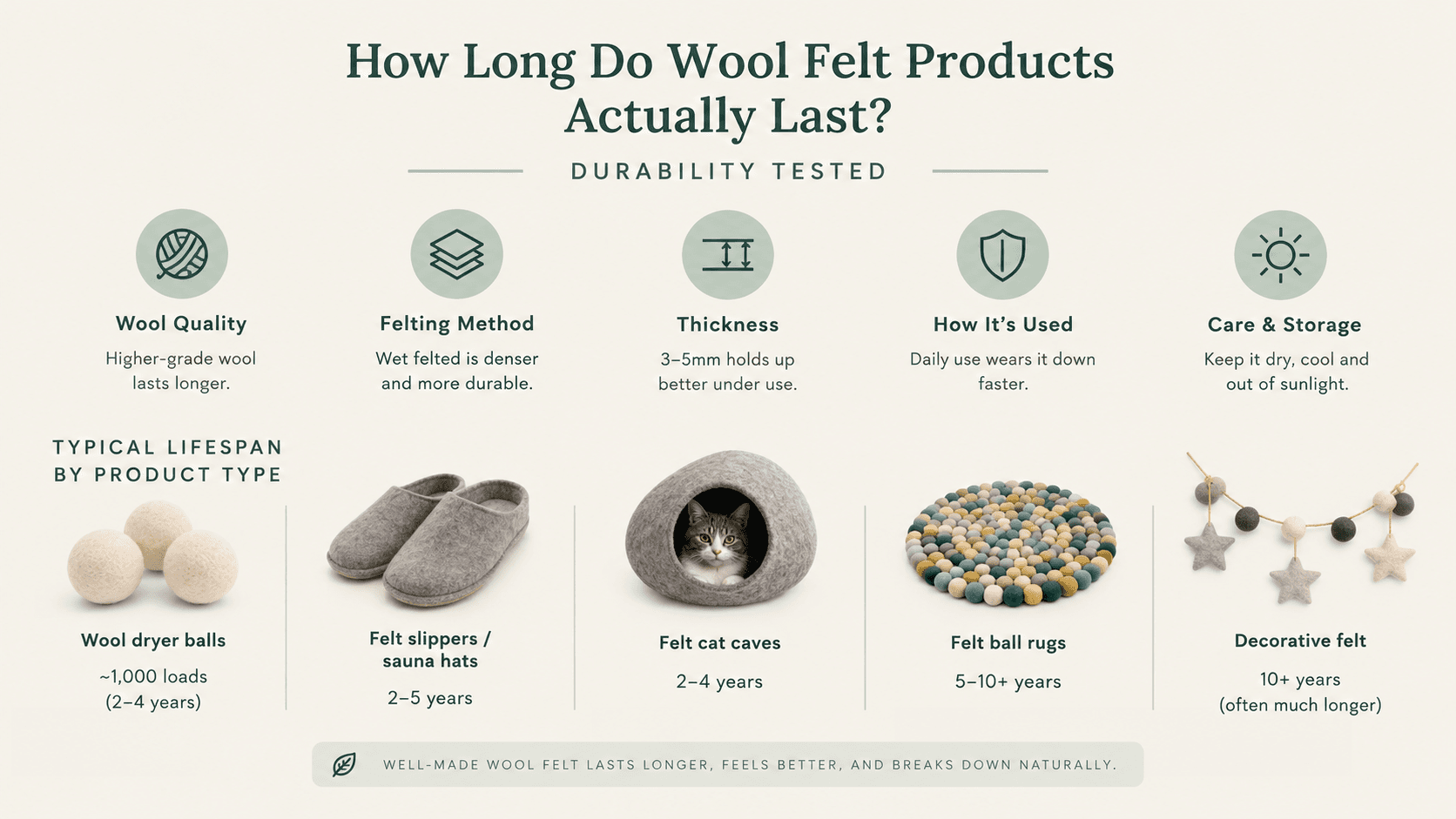
How Long Do Wool Felt Products Actually Last? (Durability Tested) — Handmade felt crafting insights from Kathmandu, Nepal
"Wool felt lasts a long time" is one of those claims that shows up on nearly every product page in this space, but it rarely comes with an actual number attached. A dryer ball and a decorative wall hanging are both "wool felt," yet one gets tossed around a hot dryer twice a week and the other just sits quietly on a shelf — so obviously, they're not going to hold up for the same amount of time. Here's a more honest, specific answer.
What Actually Determines How Long Felt Lasts
Durability in wool felt comes down to a handful of concrete factors, not a single number stamped on the material.
Wool quality. Higher-grade wool fibers are naturally more resilient and hold up to repeated compression and friction better than lower-grade or blended wool. This is the single biggest factor separating a felt product that lasts years from one that starts breaking down in months.
How it was felted. Wet felting — the traditional method of matting fibers together through moisture, heat, and agitation — produces a denser, more tightly bound material than needle felting, which tends to be looser and less robust. Denser felt simply has more structural integrity to wear down before it fails.
Thickness. Thicker felt (generally in the 3–5mm range) holds up noticeably better under heavy daily use than thin, lightweight felt, which is better suited to low-wear decorative pieces.
How it's actually used. This is the factor most reviews skip over entirely. An item that gets handled, walked on, or tossed in a hot dryer daily is working under completely different conditions than something that sits still on a shelf.
Care and storage. Keeping felt dry, out of direct sunlight, and free of prolonged moisture exposure has a bigger impact on lifespan than almost anything else on this list — more on that below.
Realistic Lifespan by Product Type
Rather than one blanket number, here's a more useful breakdown based on how each type of product actually gets used:
Product Type | Typical Lifespan | Why |
|---|---|---|
Wool dryer balls | ~1,000 loads (roughly 2–4 years) | Constant heat and friction wear the felt down gradually |
Felt slippers / sauna hats | 2–5 years | Daily wear and foot pressure accelerate wear |
Felt cat caves | 2–4 years | Pet claws and kneading are harder on felt than general handling |
Felt ball rugs (dry, moderate traffic) | 5–10+ years | Distributed weight and low moisture exposure preserve structure |
Decorative felt (garlands, coasters, ornaments) | 10+ years, often much longer | Minimal handling and no repeated stress on the fibers |
These ranges assume reasonably good care. A well-made, densely wet-felted item at the top of its category can outlast these numbers by a wide margin; a loosely felted, lower-grade item can fall short of them even with careful use.
What "Aging" Actually Looks Like in Wool Felt
Here's something worth knowing upfront so it doesn't read as a defect later: wool felt doesn't stay in pristine, day-one condition forever, and that's normal. Over time, natural wool fibers can develop a slight surface fuzz or a bit of visible texture from handling — this is a characteristic of natural fiber, not a sign the product is failing. A soft fabric brush and, in some cases, gentle steam can restore the surface and even help correct minor shape changes, since wool has some natural resilience built in.
This is actually one of the meaningful differences between wool felt and synthetic felt. Synthetic felt is typically cheaper — often around a quarter of the cost of wool felt — and it doesn't develop that same surface fuzz, but it also doesn't have wool's durability, softness, or ability to be "refreshed" the way wool can. Synthetic felt that starts to wear generally just keeps deteriorating, with no real way to bring it back.
Getting the Most Life Out of What You Own
A few habits make a bigger difference than people expect:
Keep felt items dry, and let anything that does get damp air-dry fully before storing it away.
Store out of direct sunlight, which gradually fades color and can weaken fibers over years of exposure.
Looking for custom or wholesale handmade felt crafts?
Direct artisan manufacturer in Nepal • 100% pure wool • Low MOQs & worldwide shipping
Brush the surface occasionally on higher-use items like slippers or cat caves to manage fuzzing before it builds up.
Avoid compressing felt items in tight storage for long periods, since wool's ability to bounce back is a big part of what keeps it looking good over time.
The Bottom Line
There's no single honest answer to "how long does wool felt last" — it depends entirely on what the product is and how it's used, and any claim that ignores that distinction is oversimplifying. What is consistent is this: well-made, densely felted, high-grade wool consistently outlasts cheaper synthetic alternatives across every product category, and even once it does finally reach the end of its life, it breaks down naturally instead of sitting in a landfill indefinitely — which is really the last, quiet advantage wool has over nearly everything else it competes with.
Looking for Custom or Bulk Handmade Felt Crafts?
We manufacture premium 100% pure New Zealand wool felt products directly in Kathmandu, Nepal. Supporting ethical fair trade, custom OEM branding, low MOQs, and reliable worldwide express shipping.